
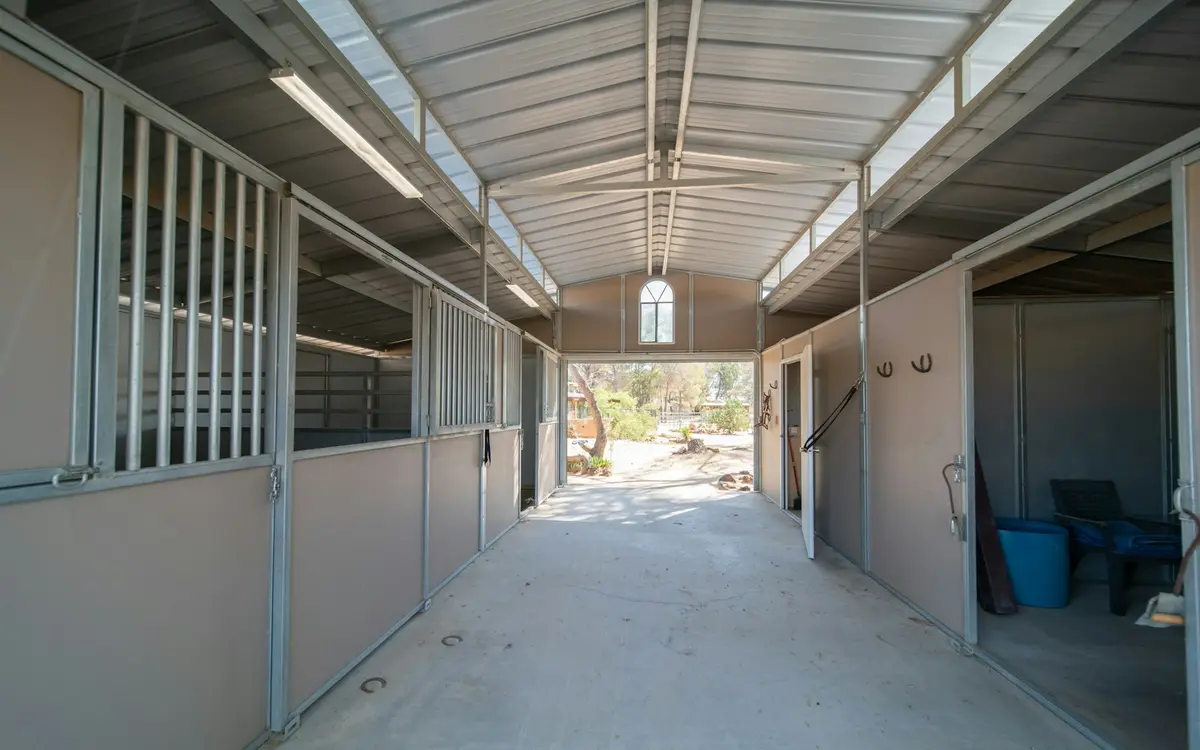
Horses count as livestock under Kent's Animals and Fowl chapter, and the city sets a high bar for keeping them. Unless the owner holds two or more acres and follows commonly approved agricultural practices, the Director of Public Safety must issue a permit, and no permit is granted for less than two acres. The stable must sit inside a corral or fence, at least 50 feet from any street, property line or city boundary, and at least 200 feet from any dwelling.
That 200-foot distance rules out most lots in town. Portage County is a different story: the 2022 Census of Agriculture counted 2,421 horses and ponies there, and the county's sales of horses, ponies and other equines ranked fifth among Ohio counties. For most Kent-area owners, the practical place to put up stalls, shelters or an indoor ring is acreage in the surrounding townships.
What to know before building in Kent
Floors and manure inside the city
Kent's permit rules require the barn or shed floor to include a sanitary disposal system approved by the Commissioner of Health, and make the owner responsible for disposing of manure in an approved manner. Kent runs its own Health Department, so we settle floor, drainage and manure storage details with that office before any concrete is poured.
Runoff rules apply everywhere
Ohio's agricultural pollution abatement rules list horses as animals and treat a bare holding area without vegetative cover as an animal feedlot. Complaints are looked into by each county's soil and water conservation district, working for the Ohio Department of Agriculture. Stalls, paddock gates and the manure pile should be placed so runoff heads away from creeks and neighbors.
Arena spans and snow
Riding indoors means a roof with no posts in the way, and the wider that roof, the more snow it holds. Arena trusses get engineered for the snow load enforced where the arena will stand, which in the townships is the Portage County Building Department. Roof pitch, snow guards over doors and the spot where sliding snow lands are planned along with the riding area.
When an arena stops being a farm building
Ohio's farm-building exemption in ORC 3781.06 can cover a private arena, since the state Board of Building Standards counts horses as livestock. An arena that also hosts paying spectators, shows or other commercial activity unrelated to the farm can be treated as a mixed-use building within the building code. We ask how the arena will be used before deciding what to submit.
Common horse barns & riding arenas projects around Kent
- Run-in shed for a small herd on township acreage
- Stall barn with tack room and hay loft
- Indoor riding arena with an attached stall wing
- Hay and bedding storage barn
- Horse barn on a Kent parcel of two acres or more that meets the 200-foot dwelling rule
Horse Barns & Riding Arenas FAQs for Kent
Is a horse allowed on a residential property in Kent?
Only on a parcel of at least two acres, and generally with a city livestock permit from the Director of Public Safety, which costs $20 a year per location. The barn must sit 50 feet from streets and property lines and 200 feet from any dwelling. Owners may ask the City Manager for an exemption from specific conditions, but neighbors within 200 feet are notified and can request a hearing.
Where do horse owners near Kent usually build?
On acreage in the townships around the city, such as Franklin Township to the north and east or Brimfield Township to the south. Building permits there come from the Portage County Building Department, which lists pole barns among the structures it permits, unless the building qualifies as agricultural. Zoning comes from the township, and Ohio law limits how townships regulate farm buildings on larger parcels.
How wide should an indoor arena be?
Arena width is a balance between riding space and truss cost. Clear span drives truss depth, the eave must be high enough for a mounted rider and any equipment you bring inside, and the roof must carry the design snow load. We price two or three widths side by side so you can see where the cost steps up before you commit.
About our horse barns & riding arenas
Stall barns, run-in sheds and indoor riding arenas planned around how horses live and work, with stall sizes, airflow and hay storage based on university extension guidance.
Sizes, materials and options