
Inside Youngstown, horses fall under Section 505.17 of the city code, which names horses, ponies, mares and colts as livestock and makes it unlawful to keep livestock anywhere in the city, inside a structure or out. The exceptions are narrow: a permit is possible only after a Health Commissioner inspection, a favorable Planning Commission review of the zoning and intended use, and City Council's consent by ordinance.
So nearly every horse barn we plan in this area sits in a township. USDA's 2022 farm census tallied 1,162 horses and ponies across 138 Mahoning County farms, and their owners ask for a short list of things done well: stalls that stay dry, hay stored close to where it's fed, a run-in shed for turnout, and, for serious riders, an indoor arena that keeps them riding through a winter averaging close to 68 inches of snow at the Youngstown-Warren airport. We design each building around the county's snow load, your horses' routine, and whether it will qualify for Mahoning County's agricultural exemption.
What to know before building in Youngstown
Pleasure riding and the county exemption
Mahoning County's agricultural exemption form ties the exemption to farm use and warns that personal, recreational or commercial use requires county approval and permits. A stall barn on a working horse farm fits comfortably. An indoor arena used mostly for pleasure riding, lessons or events is less clear-cut, so we raise it with Mahoning County Building Inspection before the exemption form is notarized and filed.
Arena footing is hard on steel
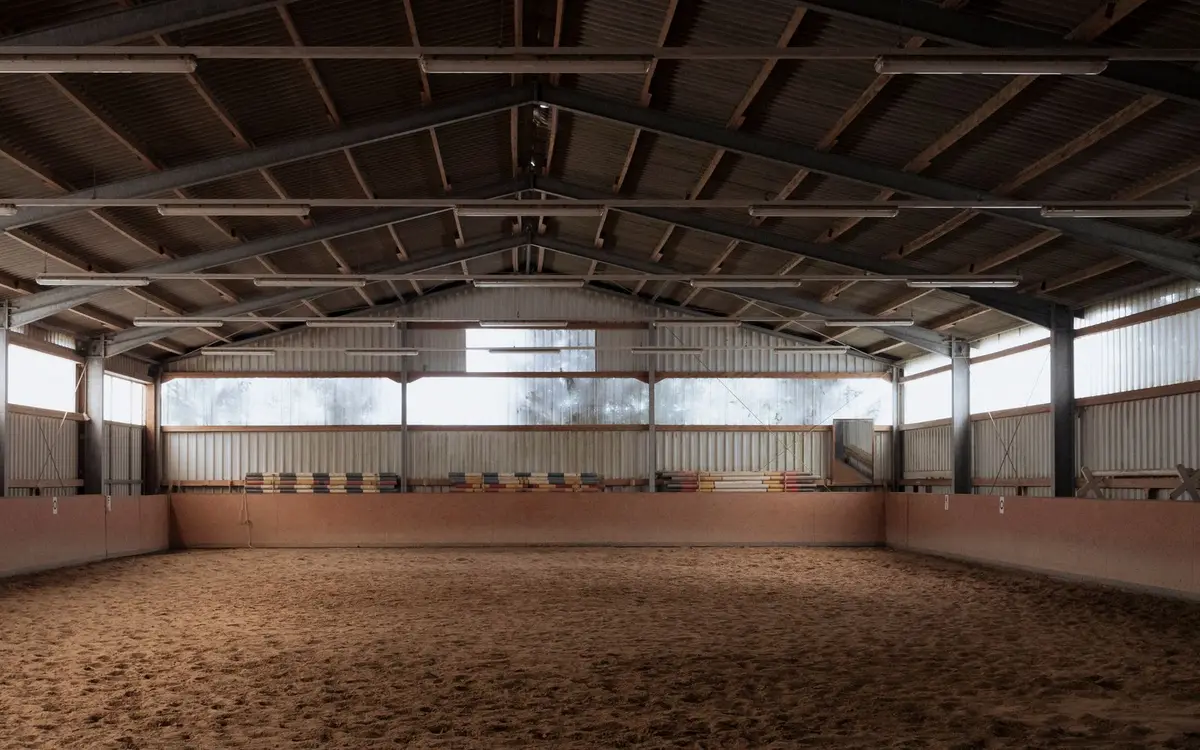
Penn State Extension notes that salt used to control dust in indoor arena footing is corrosive to metal, including arena siding and structural supports, and that dust carries the salt with it. For indoor arenas we line the lower walls with a solid wood kickwall, keep steel trim above the footing line, and leave room for a watering system so dust can be controlled without soaking the base.
Keep the stall wing breathing
When stalls share a wall with an indoor arena, Penn State Extension warns that horses on that side get no fresh air unless openings are provided there. If you want the stall wing attached to the arena for winter convenience, we add openings on the shared side or separate the two with a breezeway, so the stalls aren't drawing stale, dusty arena air all winter.
Runoff from paddocks and manure
Ohio's agricultural pollution abatement rules let the state agriculture director, or a soil and water conservation district working under an agreement, investigate complaints about agricultural pollution. An owner who cooperates gets technical help and an operation and management plan; one who doesn't can face a compliance schedule and an order. We grade around the barn and place the manure pad so runoff stays out of ditches and streams.
Common horse barns & riding arenas projects around Youngstown
- Private stall barns with a tack room and wash stall
- Indoor arenas lined with a solid wood kickwall
- Three-sided run-in sheds for turnout paddocks
- Breezeway barns linking a stall wing to an arena
- Hay lofts and ground-level hay storage near the stalls
- Covered manure storage bins on a concrete floor
Horse Barns & Riding Arenas FAQs for Youngstown
Can I keep a horse inside Youngstown city limits?
Only with a permit few properties will qualify for. Under Section 505.17, you first ask the Health Commissioner to inspect and report on what animals, if any, the property could hold. The Planning Commission must then find the land is zoned for farming and the animals are for agricultural use before recommending a permit, and City Council must consent by ordinance. Most horse owners look to township land or board their horses instead.
What snow load should an indoor arena near Youngstown be designed for?
Start with the ground snow load the building department uses; Mahoning County's published regulations list 25 psf for residential design. An arena differs from a small barn because each truss spans the full riding width with no posts to help, so we pay close attention to unbalanced snow on the downwind side of the roof, drifting against any taller or attached building, and slides off the eaves.
Does a run-in shed need a permit in Mahoning County?
On farm acreage, a run-in shed generally follows the same agricultural exemption path as a barn: a zoning certificate from your township zoning inspector, then Mahoning County's notarized exemption form. If the shed is accessory to a house on a small residential lot rather than part of a farm use, check with the township and with Mahoning County Building Inspection, which reviews accessory structures under the Residential Code of Ohio.
About our horse barns & riding arenas
Stall barns, run-in sheds and indoor riding arenas planned around how horses live and work, with stall sizes, airflow and hay storage based on university extension guidance.
Sizes, materials and options