
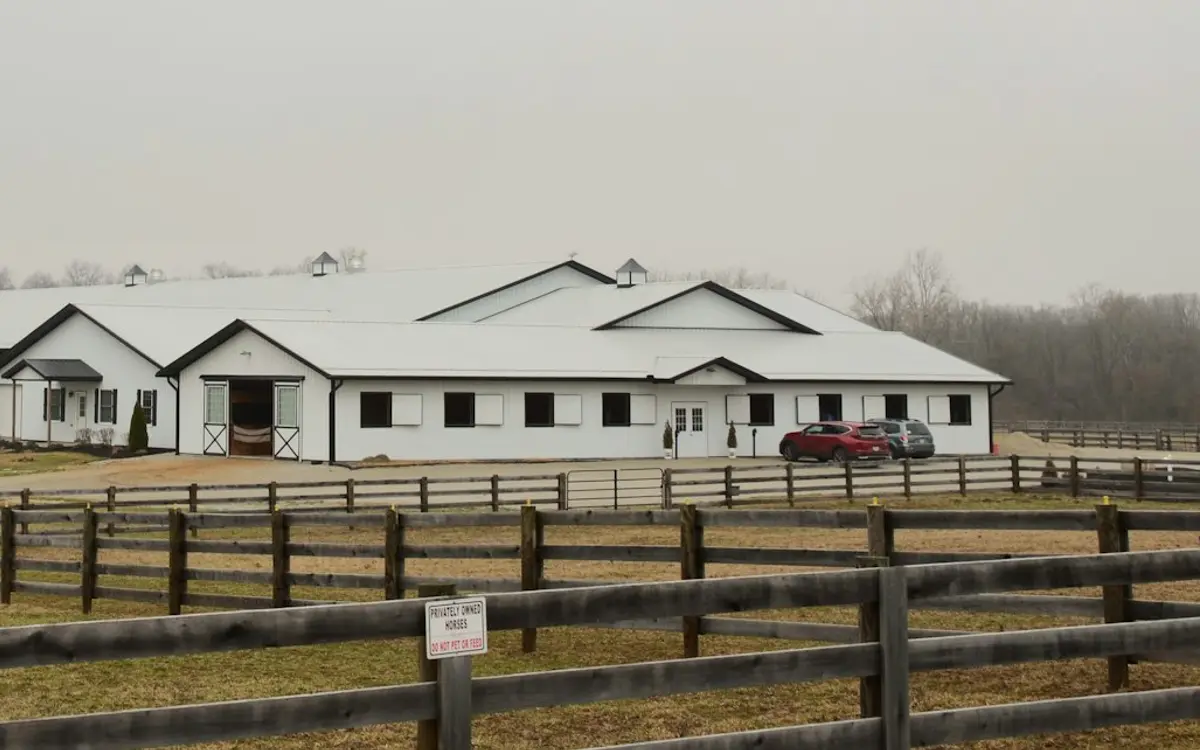
The 2022 Census of Agriculture found 1,903 horses and ponies on 329 Stark County farms, the tenth-highest county total in Ohio. The census only counts places that sell, or would normally sell, at least $1,000 of farm products a year, so many backyard horses aren't in that figure. Few live inside Canton. The city's residential use table permits agriculture only in its Municipal Agriculture (MA) district, and a separate ordinance bars housing a horse or pony within 75 feet of the nearest dwelling, a distance an ordinary city lot can't provide.
Horse barns around Canton are a township project. Ohio's township zoning statute lists the care and raising of equine animals as agriculture, so in Jackson, Plain, Perry and the county's other townships, a horse barn or run-in shed on pasture acreage is usually treated as agricultural. We plan for that from the first sketch: stall sizes, aisle width, where tack and grain are kept, how hay reaches the stalls, and how air moves in winter. Then we confirm what your township can still regulate on your lot.
What to know before building in Canton
Subdivision lots of one to five acres
Horse owners on smaller township lots should know one exception in ORC 519.21. In a platted subdivision, a township may regulate animal husbandry on lots larger than one acre and up to five acres once 35 percent of the subdivision's lots are developed, and horses already there become a nonconforming use. On subdivision lots of an acre or less, agriculture itself can be regulated. We check your plat before sizing a barn.
Stark County's notarized agricultural letter
Most horse barns need lights, fans and heated waterers. The Stark County Building Department's agricultural form is a notarized letter requesting an electrical permit for an agricultural service, stating the building is used exclusively for the farm purpose you describe. By signing, you also acknowledge that a later change of use requires plans and permits and can lead to prosecution, required alterations or removal of the building.
Lessons, boarders and spectators
Ohio's exemption is aimed at buildings tied to the agricultural use of their own parcel. The Board of Building Standards' flow chart sends buildings used partly for commercial purposes unrelated to the farm back within the scope of the building code. If an arena will host paying lesson students, clinics, shows or an audience, talk with the Stark County Building Inspection Department before relying on the exemption, and expect exits and occupancy to be reviewed.
Ventilation for a closed-up winter
Penn State Extension advises keeping a stable no more than 5 to 10 degrees warmer than outdoors rather than sealing it to stay above freezing. For cold climates it suggests at least 1 inch of continuous eave opening for each 10 feet of building width, with ridge opening area matching the eaves. We build those openings into the roof and eave details so the barn can breathe in January.
Common horse barns & riding arenas projects around Canton
- Center-aisle stall barns with tack and feed rooms
- Run-in sheds for horses kept on pasture
- Indoor riding arenas with an attached stall wing
- Hay and bedding storage with a drive-through aisle
- Lean-to additions for a wash stall or trailer parking
- Roofed manure storage bays beside the barn
Horse Barns & Riding Arenas FAQs for Canton
Are horses allowed on residential lots in Canton?
Very likely not on an ordinary residential lot. Canton's zoning use table lists agriculture as a permitted use only in the Municipal Agriculture (MA) district, and Section 505.08 of the city code requires a horse or pony to be housed at least 75 feet from the nearest dwelling. Section 505.10 also prohibits letting a stable become foul or offensive. Ask the City of Canton Zoning Department about your parcel before buying a horse or a barn.
Is a horse barn in a Stark County township exempt from the building code?
Usually it can be, once your township's zoning inspector certifies the barn for agricultural use. The state Board of Building Standards' exemption notes count horses as livestock, and Ohio's building statute counts animal husbandry as an agricultural purpose. Wiring still needs a permit; in the townships that goes through the Stark County Building Department along with its notarized agricultural letter. A commercial riding facility open to the public may be treated differently.
Where should the manure pile go?
Ohio State University Extension's horse manure fact sheet puts storage at least 50 feet away from drainage-ways and watercourses, with grass filter strips slowing runoff. We site the barn, the manure pad and the paddock gates together so stalls can be cleaned with a wheelbarrow or loader without crossing wet ground. Your Soil and Water Conservation District or NRCS office can advise on storage design and, in some cases, cost-sharing.
About our horse barns & riding arenas
Stall barns, run-in sheds and indoor riding arenas planned around how horses live and work, with stall sizes, airflow and hay storage based on university extension guidance.
Sizes, materials and options