
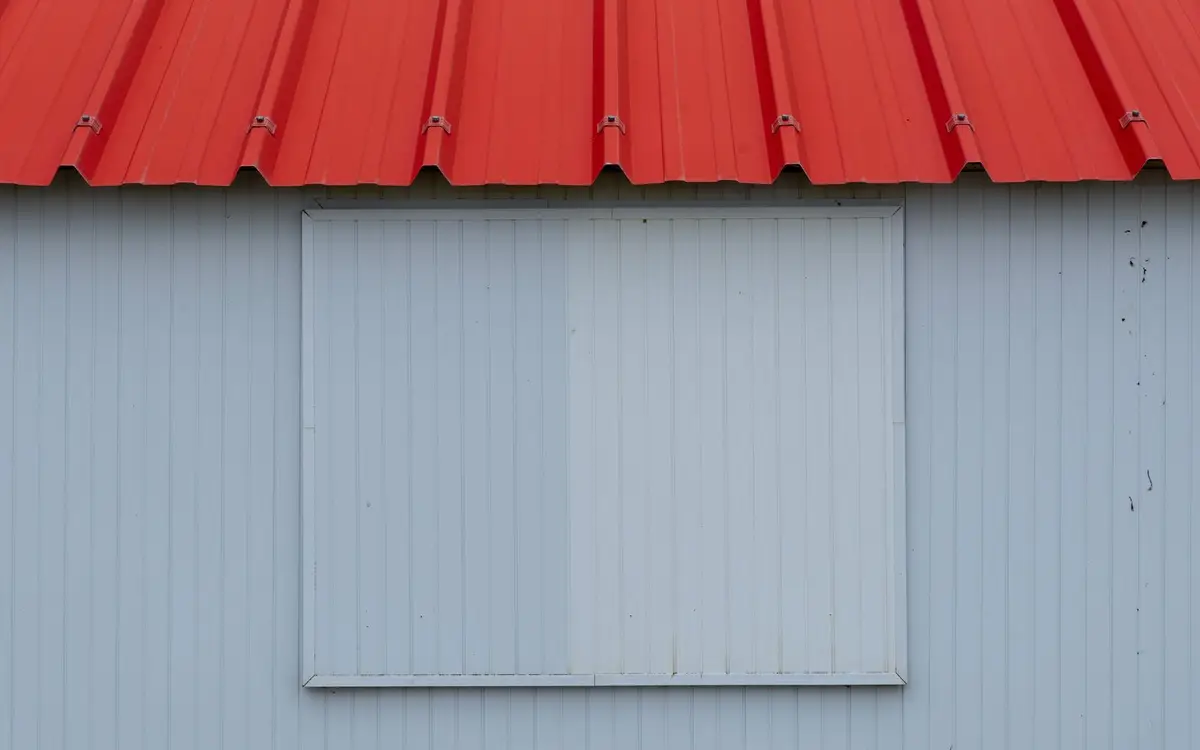
Nearly every pole barn gets steel on the roof and walls, but two quotes that both just say "steel" can describe very different buildings. The panel profile, the thickness of the sheet, the metallic coating under the paint, the paint system and the screws holding it all down decide how the building looks after twenty winters and how much upkeep it needs along the way. In a post-frame building the steel also does structural work, stiffening the roof and walls against wind. Below we go through each choice, what the technical sources say about it, and what to get written into your quote.
In a pole building, the steel is part of the structure
Steel panels screwed to the purlins and wall girts form what engineers call metal-clad wood-frame diaphragms. An NFBA technical article explains that post-frame panels are often thin, such as 26, 28 or 29 gauge, yet fastened in a regular pattern over the large roof and wall areas they create a system that resists significant in-plane forces. The roof carries wind load to the walls, and the walls carry it down to the foundation.
Two practical consequences follow. The screw type and spacing are part of the structural design, not a cosmetic detail, so they should match what the building designer specified. And cutting large new openings in a wall, or leaving wall sections unsheathed, changes how the building resists wind, so it should be checked against the design before anyone picks up a saw.
Exposed-fastener ribbed panels vs standing seam
Most pole barns use exposed-fastener ribbed panels: sheets about 3 feet wide with screws driven through the face into the framing. One widely used example, Metal Sales' Classic Rib, covers 36 inches with 3/4-inch ribs on 9-inch centers, comes in 29 and 26 gauge, and lists a minimum roof slope of 3:12. Standing seam panels hide their fasteners under raised seams and attach with clips or a slotted flange that lets each panel move as it heats and cools.
| Exposed-fastener ribbed | Standing seam | |
|---|---|---|
| Fasteners | Screws with sealing washers through the panel face | Concealed clips or slotted flange |
| Thermal movement | Screw holes can elongate over time on long panels | Designed to let the panel slide |
| Typical use (per McElroy Metal) | Agricultural, residential, light commercial | Commercial, institutional, retrofit |
| Relative cost (per McElroy Metal) | Lower | Generally higher |
McElroy Metal, a panel manufacturer, generally recommends standing seam for panel runs of 40 feet or longer, because shorter exposed-fastener panels see little expansion and contraction while long ones can work their screw holes loose. On most pole barns the eave-to-ridge run is well under 40 feet, which is why ribbed panels are the norm. Standing seam earns a look on very long or low-slope roofs, or where you simply want no exposed screws.
29 gauge vs 26 gauge
Steel gauge numbers run backward: 26 gauge is thicker than 29. The difference shows up in the manufacturer's load tables. In Metal Sales' published table for its Classic Rib panel, the 26-gauge sheet weighs 0.80 pounds per square foot against 0.63 for 29 gauge, and its allowable uniform loads are roughly 30 percent higher at the same support spacing. Heavier steel gives more margin where purlins are spaced wider, where snow loads are higher, and on walls that may take bumps from equipment.
Both are standard offerings for post-frame panels, so this is a matter of matching the sheet to the building rather than one gauge being right. What matters in a quote is that the gauge is stated for the roof, the walls and the trim separately, and that the panel's load and fastener tables support the purlin and girt spacing in the design.
Galvalume or galvanized, and the paint on top
Under the paint, the steel carries a metallic coating that does most of the rust prevention. Galvalume is a 55 percent aluminum-zinc alloy made to ASTM A792; galvanized is zinc. A GalvInfo Center technical note on aluminum-zinc coated sheet reports that the aluminum-zinc coating outlasts galvanized steel by two to four times depending on the environment. It also lists two important exceptions. Animal confinement buildings for swine, cattle and poultry produce waste by-products that can be very aggressive toward aluminum-zinc, and some steel producers will not recommend or warrant bare Galvalume there. Bare Galvalume also should not touch wet concrete. McElroy Metal likewise recommends galvanized panels, with the heaviest zinc coating available, for animal confinement. If you are building for livestock, ask which coating is quoted and whether the warranty covers that use.
The paint is the other half. Two paint families come up in pole barn quotes: silicone-modified polyester (SMP) and 70 percent PVDF fluoropolymer, often called by the Kynar trade name.
| SMP (silicone-modified polyester) | PVDF (Kynar) | |
|---|---|---|
| Resin durability | Good; a PPG coatings author writes durable polyesters may have about half the life expectancy of fluoropolymers | The longer-lived resin of the two |
| Warranty pattern | Often covers roofs and walls differently | Compare roof and wall chalk and fade terms line by line |
| Where it fits | Buildings where some fading over time is acceptable | Buildings where long-term color matters |
Screws: the part that needs looking after
With exposed-fastener steel, the screws and their rubber washers are where leaks start. McElroy Metal explains that underdriven screws leave an easy path for water, while overdriven screws may seal at first but crush the washer, which then tends to crack and erode quickly. Where a hole has elongated, the usual fix is a slightly larger replacement screw. A Central States installation manual adds a detail worth knowing during any repair: metal shavings from drilling or saw-cutting embed in the paint and rust, and the manufacturer says they can void the warranty in the affected area.
There is no universal inspection schedule, but walking the building after hail or a major wind event, and looking along the roof for screws that are backed out, tilted or missing washers, catches most problems while they are cheap to fix.
Color, fading and snow coming off the roof
All paint chalks and fades with sun. Chalk is rated under ASTM D4214 and fade under ASTM D2244, and a good warranty states both, separately from peeling. A PPG coatings author warns against warranties that offer many years of film integrity but fewer for chalk and fade, and notes that many polyester warranties treat roofs, which get more sun, differently from walls. Read those lines before choosing a dark or bright roof color.
Steel roofs also shed snow. FEMA's Snow Load Safety Guide lists metal panels among slippery roofing materials, says roofs steeper than about 6:12 to 7:12 shed snow readily, and notes that roofs as low as about 10 degrees have been seen to shed it too. Sliding snow can bury a walk door, tear off gutters, or land on a lower roof with real impact. Plan which walls the snow will come off, keep entry doors on the gable ends where you can, and use snow guards where snow must stay put. Snow guards hold the load on the roof, so the trusses have to be designed for it. Steel is also the surface where roof condensation forms; see our insulation and condensation guide before ordering, because some condensation controls are applied at the factory.
Common questions
Is 29 gauge steel good enough for a pole barn?
It can be, provided the panel's published load and fastener tables support the purlin spacing and snow load in the design. 26 gauge is thicker; in one manufacturer's table it carries roughly 30 percent more uniform load at the same spacing. It is worth considering for wider purlin spacing, higher snow loads, or walls that take equipment traffic. Make sure the quote states the gauge for roof, walls and trim.
Should a livestock barn use Galvalume or galvanized steel?
Ask before you order. A GalvInfo Center technical note reports that animal confinement buildings for swine, cattle and poultry can be very aggressive toward bare aluminum-zinc (Galvalume), and some producers will not warrant it there. McElroy Metal recommends galvanized panels with a heavy zinc coating for confinement. For an open machine shed, Galvalume generally lasts longer than galvanized. Check what the paint and coating warranty says about livestock use.
What is the difference between SMP and Kynar (PVDF) paint?
Both are factory-applied paint systems. SMP is a silicone-modified polyester used on most post-frame steel. PVDF, often sold as Kynar 500, is a fluoropolymer that resists UV breakdown better, and a PPG coatings author writes that durable polyesters may have about half its life expectancy. Compare the chalk and fade warranty terms, especially for the roof, rather than the headline number of years.
Do I need snow guards on a steel pole barn roof?
Not everywhere, but wherever sliding snow would land on a doorway, walkway, vehicle, gutter or lower roof. FEMA lists metal panels as slippery roofing that sheds snow, and sliding snow onto a lower roof adds weight and impact. Snow guards keep the snow on the roof, so the trusses must be designed to carry it. On many buildings, placing doors on the gable ends solves most of the problem.