
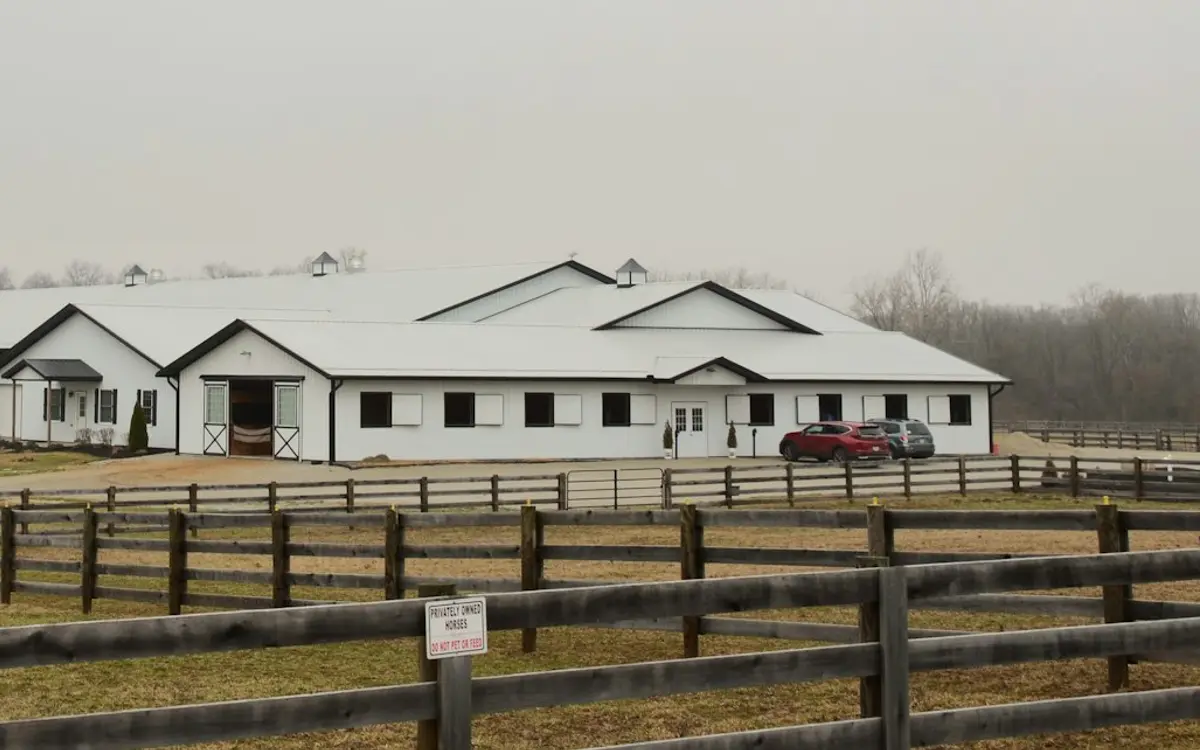
By Ohio standards, the country around Medina is busy horse country. USDA's 2022 farm census tallied 2,412 horses and ponies in Medina County, with equine sales of about $2.5 million, eighth among Ohio's counties. Those horses need shelter, stalls, hay storage and often a covered place to ride through a snowbelt winter, which is where post-frame barns and arenas come in.
Inside Medina's city limits, horses are hard to place. Agriculture is a permitted use only in the city's O-C Open Space Conservation District, which requires five-acre lots, and its rules for farm animals in residential districts are written for chickens, ducks, rabbits and similar small animals at one animal per 800 square feet of lot. We have found nothing that would allow a horse on an ordinary city lot. For a horse barn, the realistic sites are in Montville, Lafayette, York and Medina townships, where Ohio law sharply limits how townships can regulate agricultural buildings.
What to know before building in Medina
Wind and snow on a wide arena
An indoor arena combines a long clear span with tall sidewalls and big end doors, which makes it a large wind target in open farm country as well as a large snow surface. We have the trusses engineered for both loads, brace the end walls around the doors, and plan where sliding snow will land.
Neighbors do file manure complaints
In a 2016 update, the Medina Soil and Water Conservation District reported a variety of manure complaints from neighbors against horse owners, and said it must determine whether manure or tainted water reaches waters of the state. Ohio's pollution abatement rules govern manure storage and runoff, so we site piles and downspouts with that in mind.
Boarding, lessons and the building code
A private barn on farmland can qualify as a building incident to agricultural use, and on township land a zoning certificate declaring that use takes it out of the state building code. An arena that hosts paying riders, clinics or spectators is closer to an assembly or entertainment use, which the codes cover, so we confirm treatment with the county before design.
Subdivision horse lots
ORC 519.21 lets townships regulate animal husbandry on lots over one acre and up to five acres in platted subdivisions or areas of 15 or more lots, until at least 35 percent of the lots are developed, after which existing uses become nonconforming. Check the township rules before planning a barn on a smaller parcel.
Common horse barns & riding arenas projects around Medina
- Center-aisle stall barn with tack and feed rooms
- Run-in shed on a township pasture
- Indoor arena with attached stalls
- Hay storage barn sized for a winter's supply
- Covered round pen or small training arena
Horse Barns & Riding Arenas FAQs for Medina
Can I keep a horse in the City of Medina?
On an ordinary residential lot, we have not found any provision that allows it. The city's farm-animal rules for residential districts cover chickens, ducks, rabbits and similar small animals, and agriculture is a permitted use only in the O-C district on lots of five acres or more. For a horse property, look at township land around the city.
Is an indoor arena exempt from the building code?
Often, yes, when it serves the farm use of the land and is not used for retail sales; the state Board of Building Standards' notes treat horses as livestock. On township land, a zoning certificate declaring the building agricultural settles the question. Public lessons, shows or boarding businesses can change the answer, so we confirm with the Medina County Building Department.
How much stall space should I plan per horse?
Purdue Extension's minimum for a standard riding horse is a 10-by-10 box stall, growing to 10 by 14 when a mare is housed with her foal. Many owners add a removable divider between two stalls for flexibility. Aisle width, a wash stall, and tack and feed rooms set the rest of the barn's footprint.
About our horse barns & riding arenas
Stall barns, run-in sheds and indoor riding arenas planned around how horses live and work, with stall sizes, airflow and hay storage based on university extension guidance.
Sizes, materials and options