
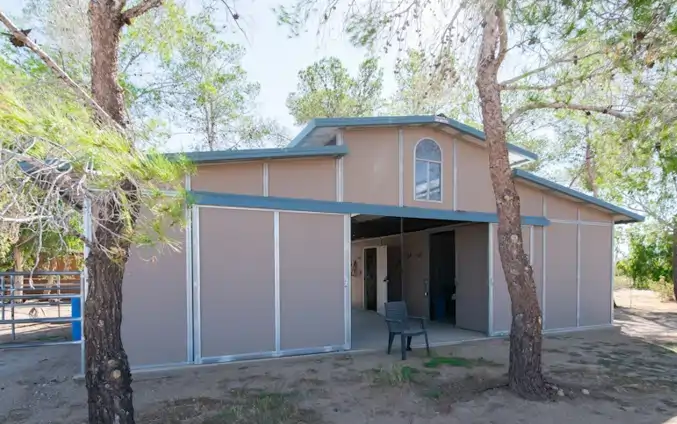
Kent is a college city of a little over nine square miles, yet its zoning code has not written farming out. Agricultural uses and buildings are permitted in two districts: O-R, Open Space-Recreation, where the minimum lot is five acres, and R-1, Low Density Residential, where lots start at 18,000 square feet. A hay barn or implement shed is therefore possible inside the city on paper. In practice, the parcels with enough room are few, and animals bring a separate set of rules from the city's Animals and Fowl chapter.
The county around Kent is still farm country. Portage County had 927 farms covering 85,762 acres in the 2022 Census of Agriculture, with soybeans, corn for grain and hay leading the crop list. Plenty of the people who work that land live in or near Kent. We begin every Kent farm project by checking the zoning district, the lot size and the nearest stream, because each one can change what we draw.
What to know before building in Kent
Livestock need two acres and usually a city permit
Kent's code defines livestock to include horses, cattle, sheep, goats and swine, and requires a permit from the Director of Public Safety to keep them. A permit is only issued for a parcel of at least two acres. Owners with two or more acres who are engaged in commonly approved agricultural practices are exempt from the permit itself, but the barn placement rules in the permit section are still a sensible design target.
Riparian setbacks along the river and creeks
Kent's riparian ordinance sets buffers on both sides of designated watercourses: 200 feet along the Cuyahoga River, 100 feet along Breakneck Creek, 50 feet along Plum Creek and Fish Creek, and 25 feet along smaller channels with a defined bed and bank. Open land near water is often exactly where a farm building is wanted, so we plot these lines before choosing a pad.
Which height limit applies
A barn treated as a subordinate building on a residential lot is held to 15 feet, with gable roofs measured halfway up, between eave and ridge. The R-1 district's general building height limit is 35 feet. Because agriculture is a permitted use in R-1 and O-R, ask Kent zoning which standard applies to your barn before the trusses are designed.
The state exemption does not cover city rules
Under Ohio Revised Code 3781.06, a barn that serves the farming use of its land and is not a retail business falls outside the state building code sections. That exemption does not waive Kent's zoning permit, the livestock ordinance or the riparian buffers. Whether a particular barn qualifies is a question for the Kent Building Division, since the county office does not serve the city.
Common agricultural buildings projects around Kent
- Hay and implement barn on an R-1 or O-R parcel
- Small livestock barn on two or more acres, set well back from homes
- Tractor and mower shed on a large residential lot
- Produce washing and storage building for a market grower
- Farm building on family acreage in a neighboring Portage County township
Agricultural Buildings FAQs for Kent
Which Kent zoning districts allow a farm building?
Kent's table of land uses permits agricultural uses and buildings in the O-R Open Space-Recreation district and the R-1 Low Density Residential district. O-R requires a five-acre lot, and R-1 lots start at 18,000 square feet, although livestock need at least two acres under a separate city ordinance. Other districts do not list agriculture, so talk to the zoning office before planning a farm use there.
Who reviews a farm building in the townships around Kent?
Outside the city, the Portage County Building Department handles building permits for townships and villages, and the township's zoning office handles zoning where a code has been adopted. State law restricts township zoning of farm uses on larger parcels, and ORC 3781.061 lets a township or county zoning certificate settle a building's farm status. That route does not apply inside Kent.
Can I sell produce from my property in Kent?
Kent permits roadside stands in the R-1 and O-R districts. The code defines them as removable structures for selling seasonal farm products grown on the premises, stored behind the building line once the season ends. A permanent farm market building is different: under ORC 3781.06 it loses the agricultural exemption if less than half of its sales come from products raised on the seller's own farms.
About our agricultural buildings
Post-frame farm buildings for equipment, hay, grain and livestock, sized to your machinery and engineered for the snow and wind loads at your site.
Sizes, materials and options